I’ve worked with children my entire career starting with babysitting when I was 12. Long before I became a mother, there was a popular question adults loved to ask children that rubbed me the wrong way every time I heard it.
What do you want to be when you grow up?
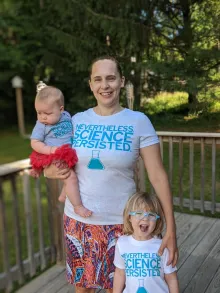
I know this is asked with the best of intentions—a desire to connect with a child and learn about them—but I can’t stand it! (And neither can Michelle Obama)
Here’s my problem. It’s such a limiting idea, with a hidden assumption that what they will be is a singular thing. What one career are you going to have for the rest of your life?
I’ve been thinking about children’s interest in STEM and STEM careers for many years. My master’s research focused on building a sense of connectedness between STEM role models and middle and high school students whose classes they visited. Researchers have found that people who are historically underrepresented in STEM need to see role models succeeding in those fields to build confidence that they too could do it. But it takes more than just seeing a professional succeeding in a STEM career to accomplish this. Students who COULD excel in STEM careers do not always choose them, and my own life story exemplifies this.
Make a Choice
I was blessed to attend a well-funded public school that offered many opportunities to explore and thrive. I was in honors math and English starting in first grade. In high school, I participated in math team, accelerated chemistry and physics, performing arts, debate, three seasons of sports, Youth in Government, and MORE!
But when I started thinking about college, I felt like the world was sending me a strong message that I needed to get serious and make a choice. I honestly don't know if this message was consciously articulated or an unconscious message, but I felt like I had to decide between my math/science-loving side or my English/social studies/theater-loving side.
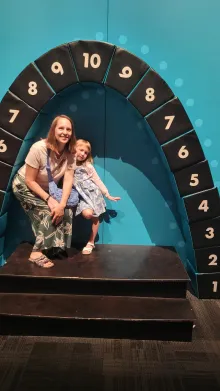
I decided to embrace my storytelling, creative, theatrical self and entered a degree program for broadcast journalism. My scores from AP calc, along with my high school honors chemistry and physics classes, meant I could achieve my undergraduate degree with only one lab-based science course. I would never have to see math or science again!
But by the end of my first semester, I was really missing math! I missed 1 + 1 = 2, next question, not "how does this make you feel?"
I decided to add a second degree in atmospheric science to balance my journalism degree. It was a sound career choice as it opened up more opportunities to apply for TV jobs. I could be a reporter and/or a meteorologist.
But more than that, I became whole again. I didn't have to pick my “right brain or my left brain” (which neuroscientists have shown is actually a myth). I was, and I am, a Renaissance Woman. I will not be put into narrow categories and I know that I'm a more valuable collaborator because of this.
I was an academically successful kid. I felt empowered to do whatever I wanted. And yet, I was still encumbered by society's message that once you're done with the frivolity of K-12, you must narrow down, pick your “pipeline” and stick to it.
We’re losing girls and other students who could, and oftentimes ARE excelling in STEM because of this message.
That's why as a mother, I tell my daughters that they do NOT have to pick just one thing. In fact, my 6-year-old proudly tells everyone that she is a Renaissance Kid who is going to be a meteorologist, community helper, dancer and a Care Bear when she grows up. You go girl!
More than STEM Identity
In the diversity in STEM realm, we talk a lot about building STEM identity. But we can’t forget about the pivotal role of intersectional identity. It is critical to acknowledge that the term “intersectionality” was coined in a 1989 paper by Kimberlé Crenshaw as a means of explaining the oppression of Black women. It has since been expanded to identity theory conversations. It plays a role in barriers (and compounding barriers for some) encountered by people who have been historically marginalized in STEM.
I am looking at intersectionality in a slightly different way. When children see a “STEM identity” in conflict with another identity they hold, they may not embrace it.
Girls can’t do STEM and I’m a girl.
STEM is for nerds and I’m not a nerd.
Artists don’t like STEM classes and I’m an artist
I want to be an entrepreneur and STEM professionals don’t start businesses.
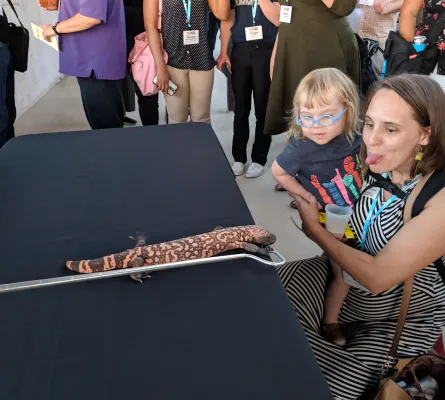
As a mother, there’s a particularly insidious challenge. Being a mom means being busy. And it’s not just lunch packing, homework helping, and event transportation. Researchers have found mothers carry 71% of the household mental tasks on top of that. We’re the planners, coordinators, and emotional support people the majority of the time. Our children see that and may wonder whether it is even possible to achieve a goal of motherhood AND have a thriving STEM career (without burning out).
All these messages, whether they're coming through the media (as researched by the Geena Davis Institute on Gender in Media in partnership with the IF/THEN Initiative), classmates, or the world around them, may lead your child to think they can not pursue a career or an interest in STEM.
But showing how we can embrace multiple identities simultaneously can combat that. Yes, you may be raising your child to be “well-rounded”, but that should be more than just a means to help them write a strong college application. They can be “well-rounded” in college and beyond.
To do this, we need to show them well-rounded adults who embrace a STEM identity as one of their many identities. Mothers can do this by embracing their own complexity. If you’re a mother, take part in a wide variety of activities, both with your children and on your own. Then come back and tell your children about what you did and why it was fun/meaningful/impactful. See an improv show. Substitute for a volleyball team. Join a book club. Volunteer at a community garden. Think back to the things you did “before you had kids” that gave you joy and bring that back into your life. It doesn’t have to be a long-term commitment. Just treat yourself to small, meaningful doses here and there. Do this while still enjoying visits to the science museum, attending the local math carnival, cheering on the robotics team and/or signing up for a hack-a-thon. Know your capacity but don’t forget to fill your cup so that you have the energy to share with others.
I’m Sara Kobilka and I’m a Renaissance Woman. I’m a meteorologist, educator, entrepreneur, gardener, fitness instructor, actor, murder mystery party host, community builder, podcast host, mother and more! I am a walking Venn diagram of interests and I encourage you to live expansively. Show your children that having a STEM identity can beautifully fit with the other identities you hold.
For more resources on being a multi-faceted STEM role model for girls, check out the SciGirls Role Model Strategies.
For examples of multi-faceted female STEM role models, watch the SciGirls Role Model Profiles videos and share the IF/THEN Collection.
Sara Kobilka
Sara Kobilka is the owner of Renaissance Woman Consulting. She helps multi-passionate Renaissance People confidently live expansive lives. Much of her work focuses at the intersection of STEM learning, communication and engagement.
Website: https://renwomanconsulting.com
Podcast: Connecting the Dots with The Renaissance People https://connecting-dots.captivate.fm/
LinkedIn: https://www.linkedin.com/in/sara-kobilka/
Facebook: https://www.facebook.com/RenWomanConsulting/
Instagram: https://www.instagram.com/the_ren_woman/